
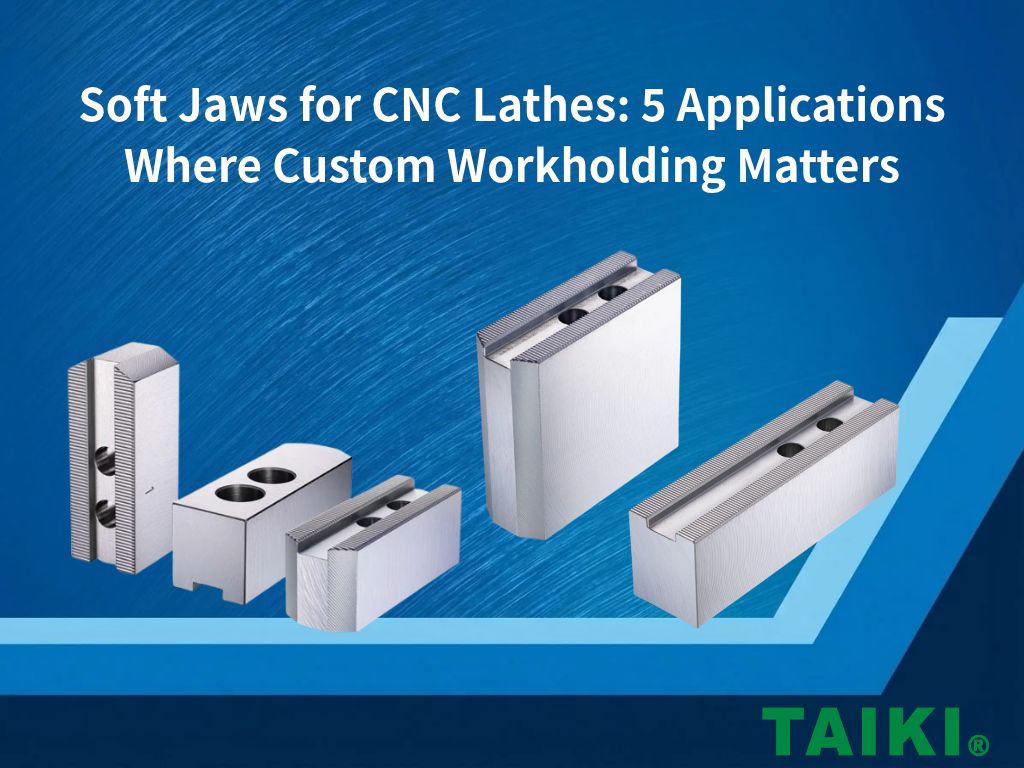
Soft jaws play an important role in CNC lathe workholding, particularly when standard gripping surfaces cannot adequately accommodate a workpiece's geometry, surface condition, or machining requirements. Unlike hard jaws intended for repeated use with compatible workpieces, soft jaws can be machined to create application-specific gripping profiles.
However, not every CNC turning operation requires the same soft jaw configuration. Thin-walled components, finished surfaces, irregular shapes, second-operation workpieces, and repetitive production each introduce different workholding challenges.
This article explores five CNC machining applications where custom workholding matters, explains how different soft jaw designs address these requirements, and outlines what manufacturers should consider before selecting lathe chuck soft jaws.
What Are Soft Jaws Used for in CNC Turning?
Soft jaws are machinable chuck jaws used to create gripping surfaces that match specific workpiece dimensions or profiles. They are commonly installed on compatible power chucks and machined to suit the required workholding arrangement.
Compared with hard jaws, soft jaws offer greater flexibility when manufacturers need to adapt the gripping profile to a particular component.
Their main functions include:
- Creating workpiece-specific gripping profiles.
- Providing suitable contact for different workpiece geometries.
- Supporting consistent positioning during repeated machining operations.
- Accommodating components that require particular gripping heights, widths, or reaches.
- Reducing unnecessary contact pressure concentration when properly designed.
The performance of a soft jaws chuck setup depends on more than the jaw material. Jaw geometry, gripping force, mounting compatibility, machining conditions, and workpiece support must all be considered.
For CNC manufacturers, the primary advantage of soft jaws is their ability to adapt the workholding arrangement to the application rather than forcing every workpiece into the same gripping configuration.
Application 1: Clamping Thin-Walled and Deformation-Sensitive Parts
Why Are Thin-Walled Components Difficult to Clamp?
Thin-walled workpieces can deform when clamping forces are concentrated over a limited contact area.
Common examples include:
- Thin-walled cylindrical housings.
- Lightweight metal sleeves.
- Hollow components.
- Parts with relatively low wall stiffness.
When excessive or uneven pressure is applied, the workpiece may become distorted while clamped. After machining and releasing the chuck, the component may recover elastically, resulting in dimensional differences from the intended geometry.
Increasing the clamping force is therefore not always an effective solution.
How Can Soft Jaws Help Reduce Deformation?
Soft jaws can be machined to provide an appropriate gripping profile for the workpiece.
For applications requiring wider gripping contact, Extra Width Soft Jaws may be considered. Their wider configuration can help distribute the clamping load across a suitable contact region.
TAIKI's extra-width soft jaws are intended for applications where jaw width and gripping contact are important considerations, including suitable thin-walled components.
However, a wider jaw does not automatically eliminate deformation. The gripping force, contact profile, workpiece wall thickness, and machining loads must still be evaluated.
Application 2: Holding Workpieces with Finished Surfaces
Why Do Finished Surfaces Require Special Workholding Considerations?
During CNC production, some components must be clamped after an earlier machining operation has already produced a finished surface.
These surfaces may have specific requirements for:
- Surface roughness.
- Dimensional accuracy.
- Concentricity.
- Cosmetic appearance.
- Protection against unwanted clamping marks.
If the gripping profile does not match the workpiece, localized contact pressure may damage the finished surface or create inconsistent positioning.
How Do Custom-Machined Soft Jaws Support Finished Parts?
Soft jaws allow machinists to prepare a gripping profile that corresponds to the component's dimensions.
A properly prepared profile can improve the consistency of contact and help avoid unnecessary pressure concentration.
For example, when holding a previously turned cylindrical surface, machinists may bore the soft jaws to create a suitable gripping diameter.
The resulting contact condition depends on accurate jaw preparation and correct setup.
Other considerations include:
- Keeping gripping surfaces clean.
- Avoiding chips between the jaw and workpiece.
- Selecting an appropriate gripping force.
- Ensuring sufficient gripping engagement.
- Checking the workpiece after trial clamping.
Soft jaws do not guarantee a mark-free surface. Their suitability depends on the material, finish requirements, and actual gripping conditions.
Application 3: Gripping Irregular or Non-Standard Workpiece Shapes
Why Are Irregular Workpieces Challenging for Standard Chuck Jaws?
Not every CNC-turned component has a simple cylindrical gripping surface.
Some workpieces contain:
- Stepped diameters.
- Protruding features.
- Recessed gripping areas.
- Unusual external profiles.
- Limited accessible clamping surfaces.
Standard jaw configurations may not provide the required contact or clearance for these geometries.
If a jaw contacts the wrong portion of the workpiece, the setup may become unstable or interfere with the machining process.
How Can Different Soft Jaw Configurations Help?
Custom workholding may require more than machining a standard jaw profile. The physical dimensions of the jaw must also accommodate the workpiece.
Depending on the application, manufacturers may consider:
Standard Soft Jaws
Suitable for machining application-specific gripping profiles when the standard jaw dimensions provide adequate access and engagement.
Extra Height Soft Jaws
Useful when a workpiece requires greater gripping height or a different vertical contact position.
TAIKI offers extra-height configurations for CNC lathe applications, including 8-inch, 10-inch, 12-inch, and 15-inch Extra Height Soft Jaws.
Extra Length Soft Jaws
Designed for applications involving large-diameter workpieces or additional gripping reach.
For more complex requirements, the machinist must also verify that the selected jaw has sufficient material for the intended gripping profile and remains within the chuck's operating limits.
Application 4: Maintaining Accuracy During Second-Operation Machining
Why Is Second-Operation Clamping Important?
Many CNC-turned components require more than one machining setup.
After the first operation, the workpiece may need to be removed, reversed, and clamped again to machine the opposite end or additional features.
This creates a new workholding challenge: the second setup must locate the workpiece consistently relative to the surfaces or features established during the first operation.
Poor gripping contact or inconsistent positioning can contribute to:
- Runout.
- Concentricity errors.
- Axial positioning differences.
- Dimensional variation.
- Additional setup and inspection time.
How Can Soft Jaws Improve Second-Operation Setup Consistency?
Machinists can bore soft jaws to match a previously machined diameter, creating a workpiece-specific gripping profile.
When properly prepared and used with an appropriate locating arrangement, this can support consistent positioning during the second operation.
For reliable results, manufacturers should consider:
- Which previously machined surface will serve as the locating reference?
- Is the gripping profile suitable for that surface?
- Does the workpiece require an axial locating stop?
- Is the gripping force appropriate for the part?
- Can the setup be repeated consistently across multiple workpieces?
Jaw boring accessories can also support preparation.
For example, jaw boring rings and jaw boring fixtures are used during soft jaw preparation to help establish the required jaw position for machining.
Application 5: Improving Repeatability in Production
Why Does Jaw Preparation Matter in Repetitive CNC Production?
Production efficiency depends on more than cutting speed.
If workpiece positioning changes between cycles, operators may need to perform additional inspections, corrections, or setup adjustments.
These interruptions can affect productivity and machining consistency.
For repeated production of the same component, a properly prepared soft jaw setup can provide a consistent gripping arrangement.
How Do Custom Soft Jaws Support Production Repeatability?
Soft jaws can be machined for a specific part profile and reused for subsequent workpieces, provided that the jaws remain in suitable condition and the setup is maintained correctly.
This can help standardize:
- Gripping location.
- Contact geometry.
- Workpiece loading.
- Setup procedures.
- Inspection and verification requirements.
For manufacturers producing several component families, different soft jaw sets may be prepared for different workpiece geometries.
However, soft jaws are not always the best choice for every repetitive operation.
Where compatible stock dimensions and production conditions allow, hard jaws may offer a practical alternative without repeated custom profile machining.
The decision should reflect both the machining requirements and the expected production volume.
Which Soft Jaw Type Is Right for Your Application?
Different soft jaw configurations address different workholding requirements.
| Soft Jaw Type | Typical Application | Main Selection Consideration |
|---|---|---|
| Standard Soft Jaws | General CNC turning and custom gripping profiles | Suitable jaw dimensions and machinable gripping surface |
| Extra Width Soft Jaws | Thin-walled or deformation-sensitive components | Wider contact configuration and appropriate clamping force |
| Extra Length Soft Jaws | Large-diameter components | Extended gripping reach and chuck operating limits |
| Extra Height Soft Jaws | Workpieces requiring a higher gripping position | Required gripping height and machining clearance |
| Special L-Type Soft Jaws | Non-standard gripping arrangements | Workpiece geometry and custom jaw configuration |
TAIKI's product range includes standard, extra-width, extra-length, extra-height, and Special L-Type soft jaws. Individual models differ in size, serration specification, and available configurations, so the specific product page should be checked before selection.
It is important to distinguish soft jaw types from other workholding products. Round Jaws, for example, are a separate product category in TAIKI's catalog and should be evaluated according to their own gripping configuration.
What Should You Check Before Selecting Soft Jaws?
Choosing suitable hydraulic chuck jaws requires an evaluation of both the workpiece and the power chuck.
The following checklist can help narrow the options.
| Selection Factor | What to Verify | Why It Matters |
|---|---|---|
| Workpiece Geometry | Diameter, length, wall thickness, gripping features | Determines the required gripping profile |
| Jaw Dimensions | Height, width, length, available machining material | Affects gripping reach and contact configuration |
| Chuck Compatibility | Mounting interface, serration pitch, bolt arrangement | Ensures the jaws fit the intended chuck |
| Gripping Force | Required force and allowable deformation | Helps prevent slipping or workpiece distortion |
| Machining Conditions | Cutting loads, spindle speed, tool access | Affects workholding stability |
| Production Requirements | Batch size, setup frequency, repeatability | Helps determine the most practical jaw configuration |
Is Serration Compatibility Important?
Yes. Soft jaws must match the chuck's mounting requirements.
TAIKI offers different serration configurations across its product range, including 1.5 mm × 60°, 3.0 mm × 60°, and 1/16" × 90° options.
These specifications are not interchangeable simply because the jaws appear similar.
Always confirm the dimensions and mounting requirements of the intended power chuck before selecting replacement jaws.
Should Manufacturers Choose Larger Soft Jaws for Better Gripping?
Not necessarily.
Larger jaws may provide additional reach or contact options, but they can also introduce different loading and clearance considerations.
The appropriate choice depends on the actual gripping position, workpiece geometry, chuck capacity, and machining conditions.
TAIKI Soft Jaws for CNC Workholding Applications
TAIKI INDUSTRIAL CO., LTD. specializes in manufacturing soft jaws for popular power chucks, along with a complete range of chuck accessories.
Our product range supports CNC manufacturers with different workholding requirements, from general turning applications to components requiring specialized jaw dimensions.
Relevant product categories include:
- Standard Soft Jaws: General-purpose machinable gripping profiles for CNC lathes.
- Extra Width Soft Jaws: Wider configurations for suitable thin-walled or deformation-sensitive workpieces.
- Extra Length Soft Jaws: Extended gripping reach for large-diameter applications.
- Extra Height Soft Jaws: Additional gripping height for compatible workpiece configurations.
- Special L-Type Soft Jaws: Options for non-standard gripping requirements.
- Jaw Boring Rings and Fixtures: Accessories supporting soft jaw preparation.
For example, TAIKI's standard soft jaws are available in different materials, serration specifications, and jaw configurations depending on the model.
Product selection should always begin with the chuck model, workpiece dimensions, and machining requirements rather than relying on the product category name alone.
Explore TAIKI's CNC workholding products and chuck accessories to identify suitable options for your application.
Frequently Asked Questions
1. Are Soft Jaws Suitable for Thin-Walled CNC Components?
Yes. Soft jaws can be machined to match a workpiece's gripping profile. Extra Width Soft Jaws may also provide a useful contact configuration for thin-walled components. However, the clamping force and workpiece stiffness must still be considered to avoid deformation.
2. Can Soft Jaws Improve Concentricity During Second-Operation Machining?
Properly bored soft jaws can support more consistent gripping of a previously machined reference surface. Actual concentricity also depends on chuck condition, jaw preparation, workpiece location, and machining setup.
3. When Should Manufacturers Choose Extra Length or Extra Height Soft Jaws?
Extra Length Soft Jaws are generally considered when larger-diameter components require extended gripping reach. Extra Height Soft Jaws are used when the application requires a higher gripping position. The final selection must account for jaw dimensions, chuck compatibility, and operating limits.
Conclusion: Match Soft Jaws to the Workholding Application
Soft jaws are not limited to one type of CNC turning operation. Their machinable gripping surfaces make them useful across applications involving thin-walled components, finished surfaces, irregular shapes, second-operation machining, and repetitive production.
However, selecting the correct soft jaws requires more than identifying the workpiece category. Manufacturers must evaluate jaw dimensions, gripping geometry, clamping force, chuck compatibility, and machining conditions together.
TAIKI offers a range of soft jaws and chuck accessories to support different CNC workholding requirements.
Looking for Soft Jaws for Your CNC Lathe?
If you are looking for soft jaws for CNC lathes, custom gripping configurations, or compatible chuck accessories, TAIKI INDUSTRIAL CO., LTD. can help you explore suitable workholding options.
Share your chuck model, workpiece dimensions, and machining requirements with our team.
Contact TAIKI