
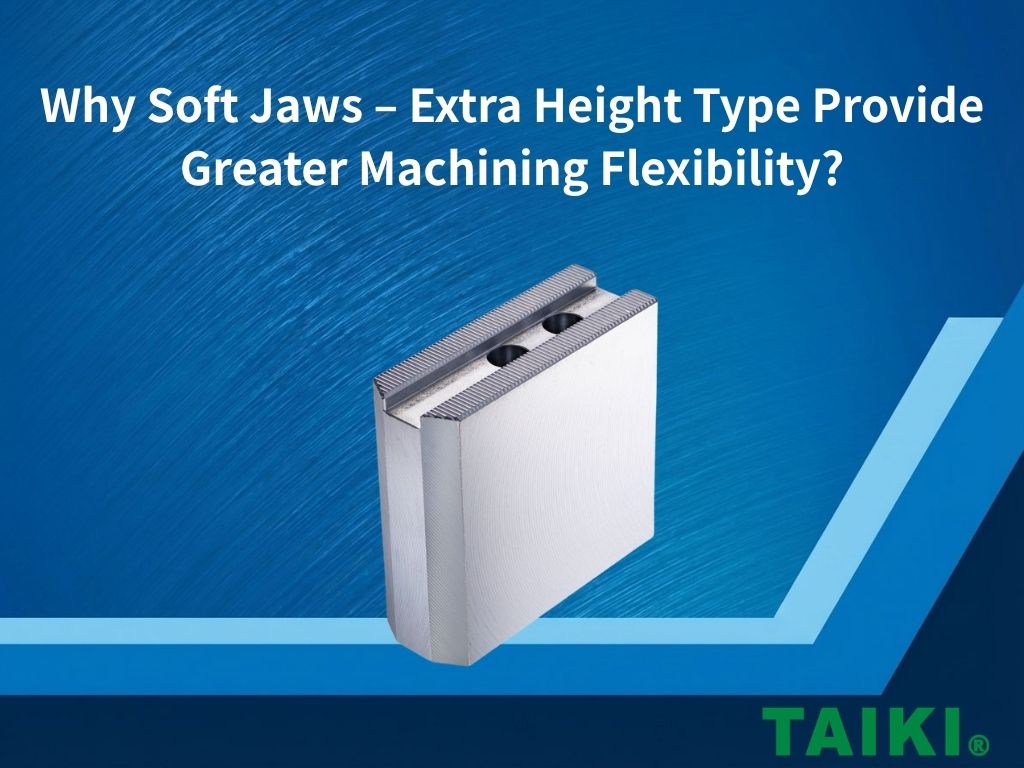
Why Soft Jaws – Extra Height Type Provide Greater Machining Flexibility?
In modern CNC turning, workholding solutions must adapt to increasingly diverse workpiece designs and production requirements. While standard soft jaws are suitable for many machining applications, certain parts require greater flexibility when creating customized clamping profiles. This is where Soft Jaws – Extra Height Type offer a clear advantage.
Unlike standard soft jaws, extra height soft jaws provide additional material above the jaw body, allowing machinists to create deeper, more complex jaw profiles without compromising structural integrity. This added machining allowance gives manufacturers greater freedom to accommodate unique workpiece geometries, support multiple machining operations, and improve long-term workholding efficiency.
At TAIKI INDUSTRIAL CO., LTD., we believe that effective workholding begins with selecting the right jaw configuration for the application. Soft Jaws – Extra Height Type are designed to provide the flexibility manufacturers need while maintaining the precision and stability expected in modern CNC machining.
Understanding Soft Jaws – Extra Height Type
Soft jaws are machinable clamping components that can be bored or profiled to match the shape of a specific workpiece. Extra Height Type soft jaws feature a taller jaw body than standard models, providing additional material for customized machining.
The increased height does not simply make the jaw larger. Instead, it creates more usable machining allowance, enabling machinists to produce deeper recesses, stepped profiles, or specialized clamping surfaces that would be difficult or impossible to achieve with standard soft jaws.
For manufacturers processing a wide variety of components, this additional flexibility can simplify setup while expanding machining possibilities.
Greater Machining Allowance for Customized Workholding
Every time a soft jaw is machined, material is removed to create a profile that matches the workpiece.
With standard soft jaws, the available machining allowance is limited. As production requirements become more complex, machinists may reach the material limit before achieving the desired profile.
Soft Jaws – Extra Height Type provide additional material that allows for:
- Deeper jaw boring
- Multi-level clamping profiles
- Larger relief areas
- Customized locating surfaces
- Greater design flexibility for unique components
This added machining allowance gives manufacturers more freedom to optimize the workholding setup without being restricted by jaw dimensions.
Supporting Complex and Specialized Workpieces
Many CNC components feature geometries that require more than a simple cylindrical clamping surface.
Examples include:
- Stepped shafts
- Multi-diameter components
- Valve bodies
- Hydraulic parts
- Custom industrial components
These workpieces often require jaw profiles with varying depths or multiple contact surfaces.
Because Soft Jaws – Extra Height Type provide additional material for machining, they allow customized profiles to be created while maintaining sufficient jaw strength. This helps improve positioning accuracy and ensures stable clamping throughout the machining process.
More Flexibility for Changing Production Requirements
Today's manufacturers often process a wide range of workpieces on the same CNC machine. Production schedules may change frequently, requiring soft jaws to be modified or re-bored for different jobs.
The additional machining allowance provided by extra height soft jaws makes these adjustments more practical.
Instead of being limited by the remaining material on a standard jaw, machinists have greater flexibility to modify the jaw profile as production requirements evolve.
This can reduce setup limitations and improve the ability to respond efficiently to changing manufacturing demands.
Supporting Long-Term Workholding Efficiency
Although every re-boring operation removes material from the jaw, starting with additional machining allowance provides greater flexibility over the usable life of the soft jaw.
For manufacturers that regularly modify jaw profiles for different production runs, extra height soft jaws may reduce the need for immediate replacement compared with standard jaws.
More importantly, they provide greater confidence when creating specialized clamping geometries, helping maintain workholding performance across multiple machining applications.
Rather than simply increasing jaw size, the additional height expands the range of machining possibilities available to CNC users.
TAIKI's Complete Workholding Philosophy
TAIKI has become the specialist in manufacturing soft jaws for all popular power chucks, along with a complete range of chuck accessories.
Our Soft Jaws – Extra Height Type are developed as part of a comprehensive workholding system. We focus on how jaw geometry, chuck compatibility, and machining requirements work together to create reliable and repeatable clamping performance.
In addition to Extra Height Type soft jaws, TAIKI offers standard soft jaws, extra width types, extra length types, round jaws, jaw boring rings, T-nuts, and other workholding accessories to support a wide variety of CNC turning applications.
By providing multiple jaw configurations, we help manufacturers select solutions that best match their production requirements while maintaining high standards of machining precision.
FAQ: Common Questions About Soft Jaws – Extra Height Type
Q1: What is the primary benefit of extra height soft jaws?
The main advantage is the increased machining allowance. The additional material allows machinists to create deeper and more complex jaw profiles for customized workholding applications.
Q2: Are extra height soft jaws suitable for standard machining operations?
Yes. Although they are particularly beneficial for customized applications, extra height soft jaws can also be used in general machining when additional flexibility for future modifications is desired.
Q3: Do extra height soft jaws improve machining accuracy?
They can contribute to improved accuracy by allowing jaw profiles to better match complex workpiece geometries, resulting in more stable positioning and consistent clamping throughout the machining process.
Related Articles
Looking for the right soft jaw solution for different machining applications? Continue exploring our Soft Jaws knowledge series:
- When Do You Need Soft Jaws – Extra Length Type in CNC Machining?
Learn how extra length soft jaws provide deeper clamping engagement and improve stability for long or overhanging workpieces. - Soft Jaws – Extra Width Type: Why Contact Area Matters in CNC Workholding Systems
Discover how a larger contact area improves force distribution, reduces vibration, and enhances workholding stability in demanding CNC applications.
Conclusion: Greater Flexibility Creates Better Workholding Solutions
As CNC manufacturing continues to evolve, workholding systems must be capable of accommodating increasingly diverse workpiece designs and machining requirements.
Soft Jaws – Extra Height Type provide manufacturers with greater machining flexibility by offering additional material for customized jaw profiles. Whether machining complex geometries, supporting changing production requirements, or creating specialized clamping surfaces, the added machining allowance allows manufacturers to adapt more efficiently while maintaining stable workholding performance.
Rather than simply adding height, these soft jaws expand the possibilities of precision workholding, enabling manufacturers to optimize their setups for greater productivity, consistency, and long-term manufacturing efficiency.
Contact TAIKI INDUSTRIAL CO., LTD. to learn more about our Soft Jaws – Extra Height Type and complete range of workholding solutions designed to support precision CNC machining across a wide variety of industries.