
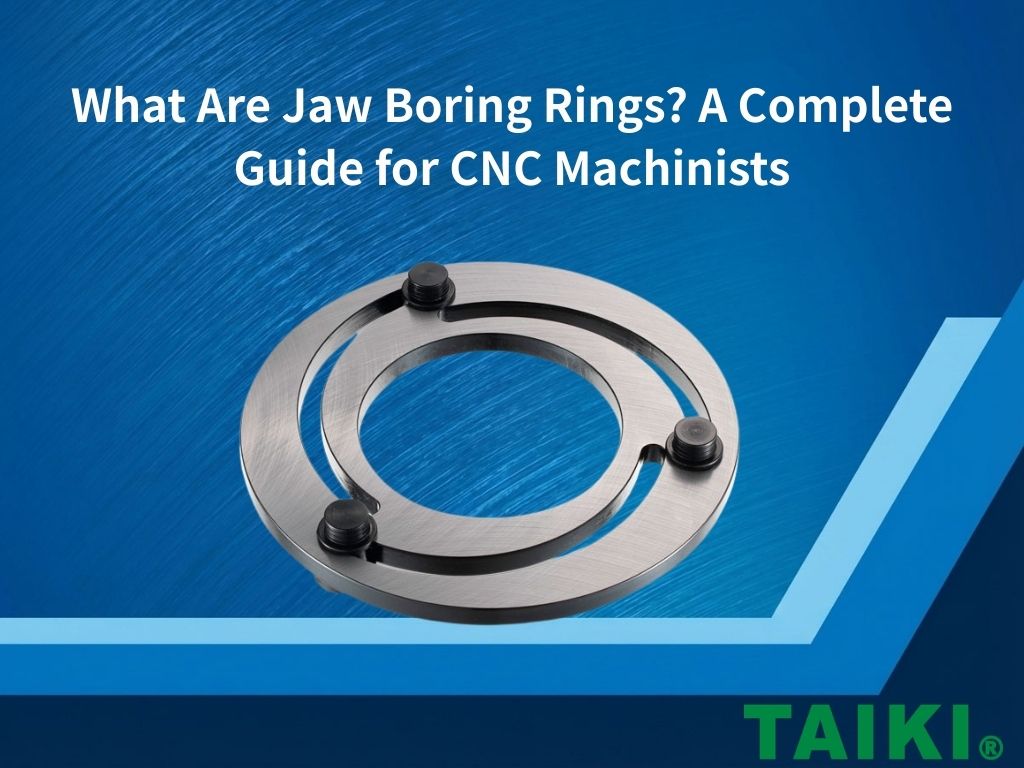
What Are Jaw Boring Rings? A Complete Guide for CNC Machinists
In CNC turning operations, workholding accuracy defines the stability of the entire machining process. While cutting tools and machine rigidity often receive the most attention, the foundation of precision begins at setup—particularly during soft jaw boring. One essential component in this stage is the Jaw Boring Ring.
At TAIKI, we view jaw boring not as a simple preparatory step, but as a controlled engineering process that determines clamping accuracy, concentricity, and long-term repeatability. Understanding the role of jaw boring rings is fundamental for machinists and manufacturers who prioritize consistent precision.
What Is a Jaw Boring Ring?
A Jaw Boring Ring is a precision accessory used to preload soft jaws before boring them on a CNC lathe. Its purpose is to simulate the actual clamping condition that will occur when a workpiece is mounted.
Soft jaws are designed to be machined to match specific part diameters. However, like all metal components, they undergo elastic deformation under clamping force. If soft jaws are bored in a neutral, unloaded state, their geometry may shift once clamping pressure is applied during real machining.
Jaw boring rings introduce controlled preload during the boring process. By replicating real clamping forces, they ensure that the machined jaw profile reflects actual operating conditions. This alignment between setup and operation is essential for maintaining machining accuracy.
From a workholding system perspective, jaw boring rings serve as a calibration tool—bridging theoretical geometry and real-world mechanical stress.
Why Soft Jaws Must Be Bored Under Load
Soft jaws are intentionally machinable so they can conform to specific workpiece geometries. However, their flexibility means they respond to clamping forces.
When soft jaws are bored without preload:
-
Bore geometry is created under relaxed conditions
-
Elastic deformation occurs later during actual clamping
-
Concentricity may shift
-
Repeatability between batches can decline
These deviations may be minimal in rough machining, but in precision applications, even small variations can influence surface finish, dimensional control, and tool performance.
By applying preload during boring, jaw boring rings stabilize jaw geometry before machining begins. This ensures that the clamping surface behaves predictably under operational stress.
For manufacturers focused on process control rather than trial-and-error adjustment, preload simulation is a critical component of stable setup methodology.
How Jaw Boring Rings Improve Concentricity
Concentricity is not merely a measurement—it is a reflection of how effectively the workholding system controls deformation under load.
Without preload compensation, jaw deflection can introduce radial deviation once the part is clamped. Over multiple production cycles, this deviation can accumulate into measurable runout variation.
Jaw boring rings minimize this risk by:
-
Ensuring jaws are bored under simulated clamping stress
-
Aligning jaw bore geometry with real clamping conditions
-
Reducing radial error caused by elastic distortion
For high-speed machining or finishing operations, improved concentricity translates into:
-
Better surface finish
-
Reduced vibration
-
Extended tool life
-
More stable dimensional control
In controlled production environments, these advantages compound over time, improving overall manufacturing efficiency.
Jaw Boring Rings vs. Boring Without Preload
In precision CNC manufacturing, jaw boring is not merely a setup procedure—it is a critical step that defines clamping accuracy throughout the entire production cycle.
When soft jaws are bored without preload simulation, the geometry is created under unloaded conditions. However, during actual machining, clamping force introduces elastic deformation and stress redistribution within the jaws. Even minimal deformation can affect concentricity, especially in tight-tolerance or high-speed applications.
Jaw boring rings introduce controlled preload during the boring process, allowing the machined jaw profile to reflect actual operational forces. The result is greater stability in concentricity, reduced runout fluctuation, and improved repeatability across production batches.
From a complete workholding solution perspective, preload simulation supports standardized setup quality and long-term dimensional consistency—both of which are essential for modern precision manufacturing.
Who Should Use Jaw Boring Rings?
Jaw boring rings are particularly valuable for:
-
CNC machinists working with tight tolerances
-
Manufacturers producing repeat precision batches
-
Automated or lights-out CNC cells
-
High-speed turning applications
-
Aerospace, automotive, and semiconductor production
In environments where consistency is mandatory rather than optional, jaw boring rings form part of a structured workholding strategy.
They help shift setup from experience-based adjustment to engineered control.
TAIKI’s Role in Complete Workholding Solutions
TAIKI has become the specialist in manufacturing soft jaws for all popular power chucks, along with a complete range of chuck accessories.
Our approach to workholding extends beyond individual components. We focus on compatibility, stability, and system integration—ensuring that soft jaws, jaw boring rings, and related accessories function as a cohesive solution.
By combining precision manufacturing with deep understanding of clamping mechanics, TAIKI supports CNC users seeking reliable and repeatable machining performance. Our jaw boring rings are engineered to provide consistent preload simulation, compatibility with major chuck systems, and durability suited for long-term industrial use.
For manufacturers committed to dimensional control and production stability, selecting the right workholding accessories is a strategic decision—not just a procurement choice.
FAQ: Common Questions About Jaw Boring Rings
Q1: Are jaw boring rings only used with soft jaws?
Yes. Jaw boring rings are primarily designed for soft jaw boring applications. Because soft jaws deform under clamping force, preload simulation ensures the bored profile matches real machining conditions.
Q2: Do jaw boring rings significantly affect machining accuracy?
In precision applications, yes. By compensating for clamping deformation during boring, they reduce runout variation and improve concentricity stability, particularly in repeat production.
Q3: Are jaw boring rings necessary for all machining operations?
Not in every case. For rough machining or non-critical tolerances, preload simulation may not be essential. However, for tight tolerances, automated setups, and high-speed turning, they are strongly recommended as part of a controlled workholding process.
Conclusion: Engineering Stability at the Setup Stage
Jaw boring rings may appear to be simple accessories, yet their role in process stability is significant. By ensuring that soft jaws are bored under realistic clamping conditions, they enhance concentricity control, reduce variability, and support repeatable production.
In precision CNC machining, stability begins before the first cut is made. It begins at setup.
☞ Contact TAIKI INDUSTRIAL CO., LTD. to learn how our soft jaws, jaw boring rings, and complete chuck accessory solutions can support your precision workholding requirements.