
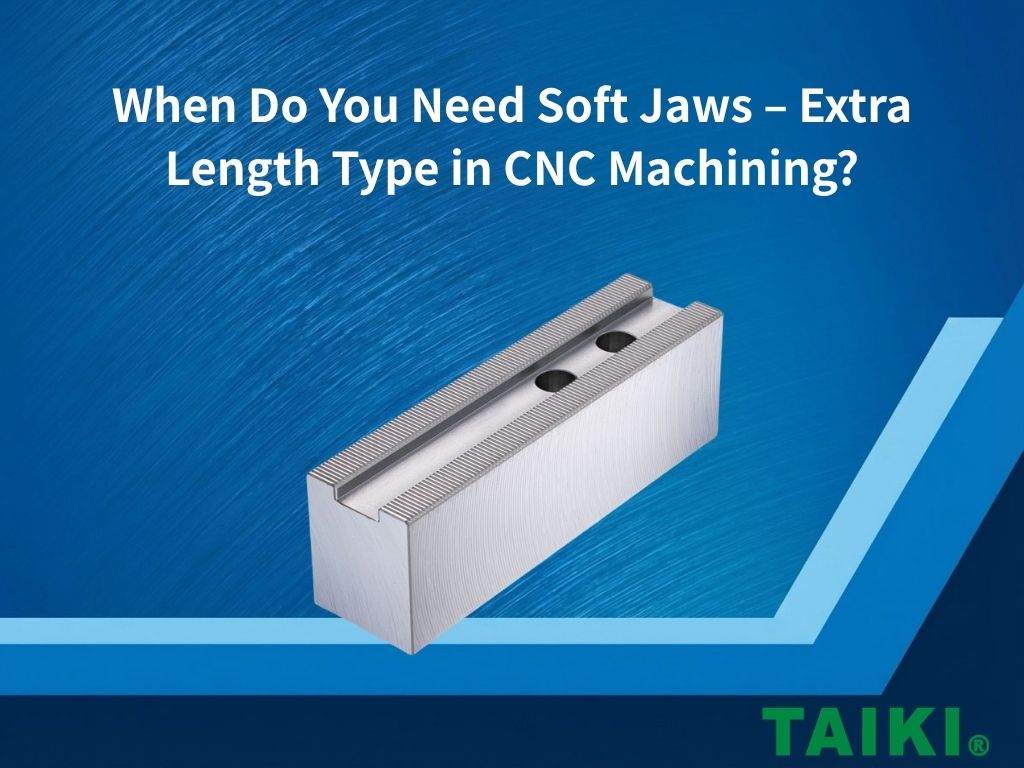
When Do You Need Soft Jaws – Extra Length Type in CNC Machining?
In CNC turning operations, selecting the right workholding solution is essential for achieving stable and accurate machining results. While standard soft jaws are widely used for general applications, certain machining conditions require a more specialized approach. One such solution is the Soft Jaws – Extra Length Type.
Extra length soft jaws are not simply longer versions of standard jaws—they are designed to address specific challenges related to workpiece support, clamping stability, and process consistency. Understanding when to use them can significantly improve machining performance and reduce production risk.
At TAIKI INDUSTRIAL CO., LTD., we provide a wide range of soft jaw solutions, including extra length types, to support diverse CNC machining requirements. This guide explains when extra length soft jaws become essential in practical applications.
Understanding Soft Jaws – Extra Length Type
Soft jaws are machinable clamping components used to hold workpieces securely during CNC turning. The extra length type features an extended jaw body, allowing for deeper clamping engagement and increased contact area with the workpiece.
This extended geometry provides additional support along the axial direction, which is particularly important when handling longer or more complex parts. By increasing the contact length, extra length soft jaws help distribute clamping force more evenly and improve overall stability.
1. Machining Long or Overhanging Workpieces
One of the most common situations where extra length soft jaws are required is when machining long or overhanging components.
In these cases:
-
The workpiece extends significantly beyond the chuck
-
Clamping force is concentrated near the base
-
Bending or deflection may occur during cutting
Extra length soft jaws increase the clamping engagement depth, providing better support along the workpiece. This reduces the risk of deflection and improves dimensional accuracy, especially in turning operations involving shafts or elongated components.
2. When Clamping Depth Is Critical for Stability
Standard soft jaws provide limited contact depth. For certain applications, this may not be sufficient to maintain stable clamping under cutting forces.
Extra length soft jaws are beneficial when:
-
Deep clamping is required
-
Cutting forces are high
-
Workpiece rigidity is limited
By extending the contact surface, they improve load distribution and reduce localized stress. This results in more stable machining conditions and less variation during operation.
3. Thin-Walled or Hollow Workpieces
Thin-walled parts are highly sensitive to clamping pressure. Uneven force distribution can lead to deformation, dimensional inaccuracy, or surface damage.
Extra length soft jaws help mitigate these risks by:
-
Providing a larger contact area
-
Reducing pressure concentration
-
Supporting the workpiece along a longer section
This is especially important in industries such as aerospace or automotive, where lightweight and thin-wall designs are common.
4. Improving Stability in High-Speed Machining
High-speed CNC turning introduces additional challenges due to centrifugal force and dynamic loading.
In these conditions:
-
Small instability can amplify into vibration
-
Poor support may lead to chatter
-
Surface finish may deteriorate
Extra length soft jaws enhance stability by increasing the mechanical support between the chuck and the workpiece. This helps maintain consistent clamping under high RPM conditions and supports smoother cutting performance.
5. Multi-Step Machining and Repeat Production
In many production environments, parts undergo multiple machining steps or are produced in large batches. Consistent clamping becomes critical for maintaining dimensional accuracy across operations.
Extra length soft jaws are advantageous because:
-
They provide more repeatable positioning
-
They reduce variation between setups
-
They support consistent alignment across batches
For manufacturers focused on process control and repeatability, using the appropriate jaw geometry is essential.
TAIKI’s Approach to Advanced Soft Jaw Solutions
TAIKI has become the specialist in manufacturing soft jaws for all popular power chucks, along with a complete range of chuck accessories.
Our extra length soft jaws are designed with system-level performance in mind. Rather than focusing solely on jaw dimensions, we consider how the jaws interact with chuck systems, clamping forces, and machining conditions.
By offering various configurations—including standard, extra height, extra width, and extra length types—we support CNC users in selecting the most suitable solution for their specific applications.
This approach ensures that workholding is not treated as a standalone component, but as an integrated part of the machining process.
FAQ: Common Questions About Extra Length Soft Jaws
Q1: Are extra length soft jaws always better than standard soft jaws?
Not necessarily. Extra length soft jaws are designed for specific applications such as long or thin-walled workpieces. For general machining, standard soft jaws may be sufficient and more cost-effective.
Q2: Do extra length soft jaws improve machining accuracy?
Yes, when used in the right conditions. By increasing contact area and support, they reduce deflection and improve stability, which contributes to better accuracy and consistency.
Q3: Can extra length soft jaws be customized?
Yes. Extra length soft jaws are often customized to match specific workpiece geometries, clamping requirements, and machining processes.
Conclusion: Choosing the Right Jaw Geometry for the Right Application
Extra length soft jaws are a specialized solution designed to address real-world machining challenges. From supporting long workpieces to improving stability in demanding conditions, they play a key role in achieving reliable CNC performance.
Selecting the correct jaw type is not just a matter of size—it is about understanding the interaction between clamping force, workpiece geometry, and machining conditions.
➤ Contact TAIKI INDUSTRIAL CO., LTD. to learn how our complete range of soft jaws and workholding solutions can support your CNC machining applications.