
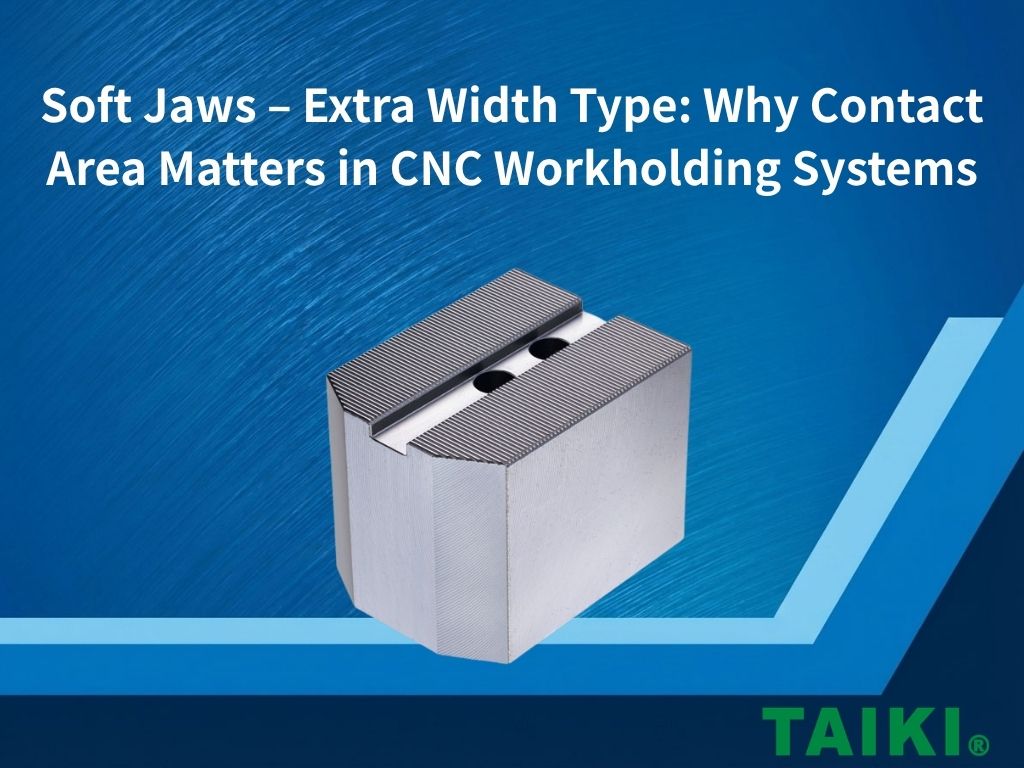
Soft Jaws – Extra Width Type: Why Contact Area Matters in CNC Workholding Systems
In CNC machining, holding a workpiece securely is just as important as cutting it accurately. While clamping force is often the first factor considered in workholding, another equally critical element is frequently overlooked: contact area.
The contact area between the soft jaw and the workpiece directly affects clamping stability, force distribution, vibration control, and machining consistency. In many applications, insufficient contact area can lead to deformation, slippage, unstable cutting conditions, and reduced machining accuracy.
This is where Soft Jaws – Extra Width Type provide a significant advantage.
At TAIKI INDUSTRIAL CO., LTD., we view workholding not simply as a clamping function, but as a complete system designed to support stable and repeatable machining performance. Understanding the role of contact area is essential when selecting the right soft jaws for demanding CNC applications.
The Relationship Between Contact Area and Clamping Stability
In a CNC chuck system, clamping force is transferred from the chuck to the jaws, and ultimately to the workpiece. However, the effectiveness of this force depends heavily on how much surface area is actually in contact.
When the contact area is too small:
-
Pressure becomes concentrated in limited regions
-
Local deformation may occur
-
Workpiece movement becomes more likely
-
Vibration and chatter can increase
A larger contact area distributes force more evenly across the workpiece surface. This reduces stress concentration and improves overall clamping stability.
From a workholding engineering perspective, increasing contact area is not simply about “holding tighter.” It is about creating more controlled and balanced force distribution during machining.
Why Standard Soft Jaws May Not Always Be Enough
Standard soft jaws are suitable for many general machining operations. However, certain applications create conditions where wider support becomes necessary.
Examples include:
-
Large diameter workpieces
-
Heavy cutting operations
-
Thin-walled components
-
Offset or uneven cutting loads
-
High-speed turning environments
In these situations, standard jaw width may provide insufficient lateral support. Even if the clamping force itself is high, limited contact width can allow localized movement or instability during machining.
This is particularly noticeable in operations involving interrupted cutting, aggressive feed rates, or high spindle speeds.
How Soft Jaws – Extra Width Type Improve Workholding Performance
Soft Jaws – Extra Width Type are designed with an expanded jaw body to increase the clamping surface area.
Compared with standard jaws, extra width types provide:
-
Wider contact engagement
-
Improved lateral support
-
Better force distribution
-
Reduced localized pressure
-
Greater resistance to workpiece movement
This wider geometry helps stabilize the workpiece under demanding machining conditions.
In practical applications, the result is often:
-
Improved dimensional consistency
-
Reduced vibration
-
Better surface finish
-
Lower risk of slippage
-
More stable machining performance
By improving contact mechanics rather than simply increasing clamping force, extra width soft jaws contribute to more reliable production outcomes.
Reducing Workpiece Deformation Through Better Force Distribution
One common misconception in workholding is that stronger clamping automatically improves stability.
In reality, excessive localized pressure can create new problems.
For thin-walled or delicate workpieces, concentrated force may cause:
-
Ovality
-
Surface marking
-
Distortion
-
Loss of dimensional accuracy
Soft Jaws – Extra Width Type help reduce these risks by distributing clamping force over a broader surface area.
This approach lowers surface pressure while maintaining stable holding performance, making extra width jaws especially valuable in precision machining applications where dimensional integrity is critical.
The Importance of Contact Area in High-Load CNC Turning
As cutting loads increase, the stability requirements of the workholding system become more demanding.
Heavy-duty CNC turning operations generate:
-
Higher radial cutting forces
-
Greater vibration energy
-
Increased dynamic stress on jaws and workpiece
Under these conditions, wider jaw contact provides greater mechanical support and improves resistance to lateral movement.
This is why extra width soft jaws are commonly used in applications involving:
-
Large flanges
-
Heavy shafts
-
Industrial machinery components
-
Large-diameter cylindrical parts
For manufacturers focused on process consistency, jaw geometry becomes an important factor in controlling machining behavior.
TAIKI’s Approach to Advanced Workholding Solutions
TAIKI has become the specialist in manufacturing soft jaws for all popular power chucks, along with a complete range of chuck accessories.
Our Soft Jaws – Extra Width Type are developed with system-level workholding performance in mind. We focus not only on jaw dimensions, but also on how jaw geometry interacts with clamping force, workpiece behavior, and machining conditions.
By offering multiple jaw configurations—including standard, extra width, extra height, and extra length types—TAIKI supports CNC users in selecting workholding solutions tailored to specific production challenges.
This approach ensures that workholding is not treated as a standalone component, but as an integrated part of the machining process.
FAQ: Common Questions About Soft Jaws – Extra Width Type
Q1: Are extra width soft jaws only used for large workpieces?
No. While they are commonly used for large or heavy components, extra width soft jaws are also beneficial for thin-walled or delicate parts that require better force distribution and reduced surface pressure.
Q2: Do extra width soft jaws increase clamping force?
Not directly. The chuck provides the clamping force. Extra width soft jaws improve how that force is distributed across the workpiece surface, resulting in more stable and balanced clamping conditions.
Q3: Can extra width soft jaws improve machining accuracy?
Yes. By increasing contact area and reducing localized movement, they help improve stability, reduce vibration, and support more consistent dimensional control during machining.
Conclusion: Contact Area as a Key Element of Workholding Stability
In CNC machining, contact area plays a critical role in determining how effectively a workholding system performs under load.
Soft Jaws – Extra Width Type provide a practical solution for improving force distribution, reducing deformation risk, and enhancing machining stability in demanding applications.
Rather than relying solely on higher clamping force, modern workholding strategies focus on creating controlled and balanced contact conditions—and jaw geometry is a key part of that approach.
☛ Contact TAIKI INDUSTRIAL CO., LTD. to learn more about our Soft Jaws – Extra Width Type and complete workholding solutions for precision CNC machining.