
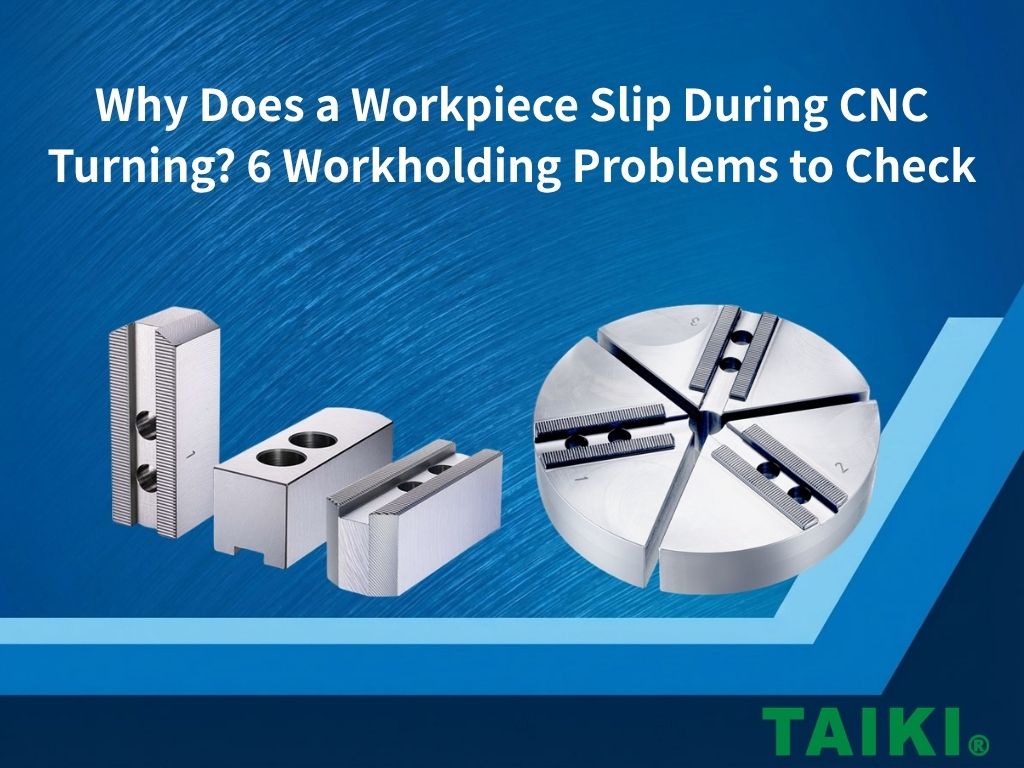
Workpiece slipping during CNC turning can lead to dimensional errors, poor surface finishes, tool damage, and unexpected production interruptions. Even when a power chuck appears to hold a component securely, unsuitable jaw contact, incorrect clamping conditions, or worn workholding components may allow the workpiece to shift under cutting forces.
A reliable workholding setup involves more than applying sufficient clamping force. The chuck jaws must match the workpiece geometry, provide appropriate contact, and maintain a secure gripping condition throughout the machining process.
At TAIKI INDUSTRIAL CO., LTD., we specialize in manufacturing soft jaws for popular power chucks, along with hard jaws and a complete range of chuck accessories. Understanding common workholding problems helps CNC operators select suitable clamping jaws and establish more reliable machining setups.
This guide explains six common causes of workpiece slipping during CNC turning, how to identify them, and what to consider when selecting CNC workholding solutions.
Quick Answer: Why Does a Workpiece Slip During CNC Turning?
Workpiece slipping during CNC turning usually occurs when the available gripping resistance is insufficient to withstand the forces generated during machining.
Six common workholding problems can contribute to this condition:
- Insufficient or incorrectly applied clamping force
- Poor contact between chuck jaws and the workpiece
- Unsuitable chuck jaw selection
- Incorrect clamping position or excessive workpiece overhang
- Worn, damaged, or improperly installed workholding components
- Workpiece geometry or cutting conditions that exceed the setup's gripping capability
These problems may occur individually or together. Increasing chuck pressure alone is not always the correct solution, particularly when machining thin-walled, delicate, or irregularly shaped components.
The first step is to identify which part of the workholding setup is limiting gripping stability.
Problem 1: Insufficient or Incorrect Clamping Force
Why can incorrect clamping force cause workpiece slipping?
Clamping force must be sufficient to resist cutting forces without causing unacceptable workpiece deformation.
When the available gripping force is too low, the workpiece may rotate or shift within the chuck jaws during machining. This is especially concerning during operations involving substantial cutting loads.
However, excessive clamping force can also create problems. Thin-walled or delicate workpieces may deform under high pressure, affecting dimensional accuracy and surface quality.
How to improve clamping force control
Operators should evaluate the required gripping force according to:
- Workpiece material and geometry
- Cutting depth, feed rate, and cutting conditions
- Chuck specifications and operating speed
- Jaw contact conditions
- Allowable workpiece deformation
For hydraulic power chucks, the relationship between hydraulic pressure and actual gripping force depends on the chuck mechanism and operating conditions. Centrifugal effects at higher spindle speeds can also change the effective gripping force.
Key Takeaway: Stable CNC workholding requires an appropriate gripping force, not simply the highest available chuck pressure.
Problem 2: Poor Contact Between Chuck Jaws and the Workpiece
How does jaw contact affect workholding stability?
Even when sufficient clamping force is available, poor contact between the chuck jaws and workpiece can reduce gripping stability.
If the jaw profile does not properly match the workpiece, the contact may be concentrated in a small area or distributed unevenly.
This can contribute to localized pressure, workpiece deformation, or movement during cutting.
How to improve jaw contact
The correct solution depends on the workpiece shape and machining requirements.
Soft Jaws can be machined to create a gripping profile that matches a specific workpiece.
Extra Width Soft Jaws may be useful when a wider gripping surface is needed, particularly for workpieces susceptible to deformation.
Round Jaws can provide an alternative contact configuration for suitable cylindrical or large-diameter components.
The objective is not always to maximize contact area. Instead, the jaw design should provide suitable contact at the correct gripping position while maintaining the required clearance and machining accessibility.
Key Takeaway: Proper jaw-to-workpiece contact is essential for transferring gripping force effectively and maintaining stable workholding.
Problem 3: Using the Wrong Type of Chuck Jaws
Can incorrect chuck jaw selection cause slipping?
Yes. Different chuck jaw designs serve different machining requirements. Selecting a jaw type that does not match the workpiece or production process may result in inadequate contact, limited gripping range, or an unsuitable clamping configuration.
For example, hard jaws may be practical for repeated gripping of compatible stock dimensions, while machinable soft jaws provide greater flexibility for workpiece-specific profiles.
Which chuck jaws should you consider?
| Chuck Jaw Type | Typical Workholding Consideration |
|---|---|
| Standard Soft Jaws | Custom-machined gripping profiles for general CNC turning |
| Hard Jaws | Durable, reusable gripping for compatible workpieces and repetitive operations |
| Extra Width Soft Jaws | Wider contact configurations for suitable workpieces |
| Extra Length Soft Jaws | Extended jaw dimensions for applications requiring additional reach or gripping coverage |
| Extra Height Soft Jaws | Greater gripping height for suitable workpiece configurations |
| Round Jaws | Circular gripping configurations for compatible cylindrical or large-diameter workpieces |
The appropriate jaw type must also match the chuck's mounting interface, serration specifications, and other compatibility requirements.
Key Takeaway: Selecting suitable chuck jaws is a fundamental part of preventing workpiece movement during CNC turning.
Problem 4: Incorrect Clamping Position or Excessive Overhang
Why does workpiece overhang affect gripping stability?
A workpiece that extends too far beyond the chuck jaws can create greater bending moments at the gripping location.
As cutting forces act on the unsupported portion of the workpiece, the setup may experience deflection, vibration, or increased demands on the jaw-to-workpiece interface.
These effects can contribute to machining instability and, in severe cases, workpiece movement.
How to improve the clamping position
Operators should consider:
- Reducing unsupported workpiece length where practical
- Selecting an appropriate gripping position
- Maintaining sufficient gripping engagement
- Checking tool access and collision clearance
- Using additional support, such as a tailstock or steady rest, when appropriate
Extended jaw configurations may help accommodate certain workpiece geometries, but longer jaws do not automatically increase gripping security. Jaw dimensions, chuck limitations, and the forces acting on the setup must be evaluated together.
Key Takeaway: Correct clamping position and workpiece support can be just as important as jaw selection.
Problem 5: Worn, Damaged, or Improperly Installed Chuck Jaws
How can worn chuck jaws affect CNC workholding?
Chuck jaws and related mounting components experience repeated loading, contact, and mechanical stress during production.
Over time, wear or damage can affect the gripping surfaces or the way the jaws are positioned and secured to the chuck.
Potential warning signs include:
- Visible damage or excessive wear on gripping surfaces
- Loose or incorrectly installed jaw mounting components
- Inconsistent workpiece positioning
- Chips or contamination between mounting surfaces
- Reduced gripping stability during repeated operations
Jaw T-nuts and other mounting components should also be checked for correct installation and compatibility.
How to prevent jaw-related workholding problems
Operators should inspect the chuck jaws and mounting components as part of routine machine maintenance.
Before machining, confirm that the jaws are correctly installed, the mounting surfaces are clean, and the workpiece can be securely clamped.
If a jaw or mounting component is damaged or excessively worn, it should be replaced according to the manufacturer's instructions.
Key Takeaway: Regular inspection of chuck jaws and mounting components helps prevent avoidable workholding problems.
Problem 6: Workpiece Geometry and Cutting Forces Are Not Properly Considered
Why do workpiece shape and cutting conditions matter?
A workholding setup that performs well with one workpiece may be unsuitable for another, even when both parts are machined on the same CNC lathe.
Thin-walled components, irregular profiles, large-diameter workpieces, and long parts can introduce different clamping challenges.
Cutting conditions also affect the forces that the workholding system must resist.
For example, increasing depth of cut or feed rate can increase cutting loads, potentially exceeding the gripping capability of an otherwise acceptable setup.
How to match workholding to the machining process
Consider the following factors before selecting a clamping arrangement:
- Workpiece diameter, length, and wall thickness
- Available gripping surface
- Material and surface condition
- Cutting depth and feed rate
- Required machining accuracy
- Need for additional workpiece support
For thin-walled components, selecting a suitable jaw contact configuration may help distribute clamping loads more appropriately.
For long or heavy workpieces, additional support and careful evaluation of chuck capacity may be necessary.
Key Takeaway: Effective CNC workholding requires matching the gripping arrangement to both workpiece geometry and expected cutting forces.
Workholding Troubleshooting Checklist
When a workpiece slips during CNC turning, the following checklist can help identify potential causes.
| Workholding Problem | What to Check | Possible Corrective Action |
|---|---|---|
| Insufficient gripping force | Chuck specifications, operating conditions, required gripping force | Verify and adjust the setup within manufacturer limits |
| Poor jaw contact | Contact position, jaw profile, workpiece geometry | Select or machine a more suitable jaw profile |
| Unsuitable chuck jaws | Jaw type, gripping range, chuck compatibility | Choose jaws that match the machining application |
| Excessive workpiece overhang | Unsupported length, clamping position, cutting loads | Improve gripping position or add suitable support |
| Worn or incorrectly installed jaws | Jaw condition, mounting surfaces, T-nuts | Inspect, clean, reinstall, or replace components as appropriate |
| Excessive cutting loads | Depth of cut, feed rate, workpiece geometry | Review cutting conditions and workholding capacity |
Important: If workpiece movement is suspected, stop machining and inspect the setup before restarting. Never attempt to adjust a chuck or workpiece while the spindle is rotating.
This checklist helps identify possible causes, but the final corrective action should follow the chuck manufacturer's operating instructions and the machine's safety requirements.
How to Select the Right Chuck Jaws for Stable CNC Turning
The right chuck jaws should provide appropriate contact, sufficient gripping engagement, and compatibility with the intended machining operation.
Rather than selecting jaws based only on their dimensions, CNC operators should consider three questions.
1. Does the jaw configuration match the workpiece?
Standard Soft Jaws can be machined to fit specific workpiece profiles. Extra Width Soft Jaws and Round Jaws may provide useful alternatives for applications requiring different gripping contact configurations.
2. Does the jaw type match the production process?
Hard Jaws may be appropriate for repetitive machining of compatible workpieces, while Soft Jaws provide flexibility for custom profiles and changing machining requirements.
3. Are the jaws compatible with the power chuck?
Jaw selection must account for mounting dimensions, serration specifications, gripping range, and other chuck compatibility requirements.
A suitable jaw design should also allow sufficient tool clearance and remain within the chuck manufacturer's operating limits.
The best workholding solution is not necessarily the strongest or largest jaw. It is the jaw configuration that matches the workpiece and machining requirements.
TAIKI's Approach to CNC Workholding Solutions
TAIKI INDUSTRIAL CO., LTD. manufactures soft jaws and accessories for power chucks, supporting different CNC turning and workholding requirements.
Our product range includes Standard Soft Jaws, Extra Width Soft Jaws, Extra Length Soft Jaws, Extra Height Soft Jaws, Round Jaws, Hard Jaws, Jaw T-Nuts, Jaw Boring Rings, and Jaw Boring Fixtures.
Each product category addresses different aspects of workpiece gripping, jaw preparation, or chuck setup.
By considering the workpiece, chuck configuration, and machining process together, manufacturers can select workholding components that better support their production requirements.
FAQ: Common Questions About CNC Workholding
Q1: Can increasing chuck pressure prevent workpiece slipping?
Increasing chuck pressure may help when insufficient gripping force is the actual cause, but it is not always the correct solution. Poor jaw contact, excessive overhang, incorrect jaw selection, or unsuitable cutting conditions may require different corrective actions. Excessive pressure can also deform sensitive workpieces.
Q2: Are Soft Jaws better than Hard Jaws for preventing workpiece slipping?
Neither type is universally better. Soft Jaws can be machined to match specific workpiece profiles, while Hard Jaws provide durable gripping surfaces for compatible applications. The appropriate choice depends on workpiece geometry, surface condition, machining loads, and production requirements.
Q3: How can manufacturers improve CNC workholding repeatability?
Manufacturers can improve workholding repeatability by maintaining consistent jaw preparation, selecting appropriate gripping profiles, inspecting chuck components, and following standardized setup procedures. Jaw Boring Rings and Jaw Boring Fixtures can support soft jaw preparation when used correctly.
Q4: Can worn chuck jaws cause machining accuracy problems?
Yes. Excessively worn or damaged chuck jaws may affect gripping contact and workpiece positioning. Regular inspection of jaws, mounting surfaces, and related chuck parts helps maintain reliable workholding conditions.
Conclusion: Improve CNC Turning Stability with the Right Workholding Setup
Workpiece slipping during CNC turning is not always caused by insufficient chuck pressure. Poor jaw contact, unsuitable jaw selection, excessive overhang, worn components, and incompatible cutting conditions can also contribute to unstable machining.
By identifying these six common workholding problems, CNC operators can make more informed decisions about jaw selection, setup preparation, and machining conditions.
If you are looking for CNC workholding solutions, soft jaws, hard jaws, round jaws, or compatible chuck accessories, contact TAIKI INDUSTRIAL CO., LTD. to discuss suitable products for your machining requirements.