
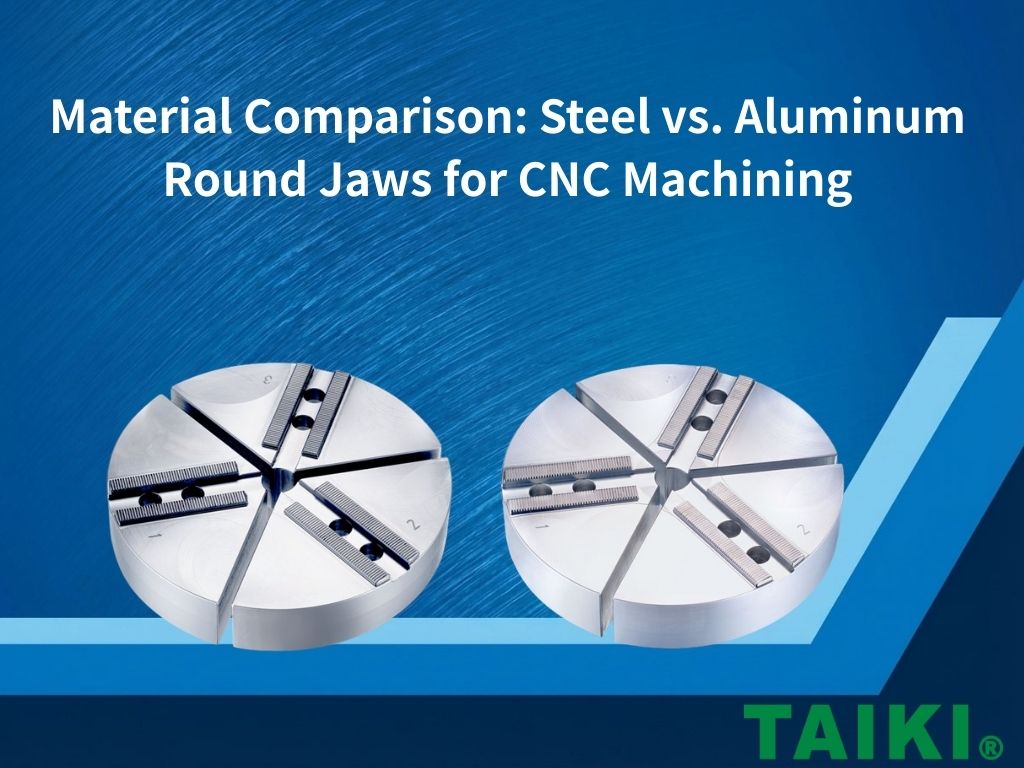
Material Comparison: Steel vs. Aluminum Round Jaws for CNC Machining
In CNC machining, workholding precision directly determines product quality, tool life, and operational efficiency. Among various chuck jaw types, Round Jaws play a critical role in holding cylindrical or delicate components securely while maintaining concentricity. But when selecting the right jaws, one important question arises: Should you choose steel or aluminum round jaws?
At TAIKI INDUSTRIAL CO., LTD., we manufacture a wide range of high-quality round jaws to meet diverse machining requirements. With decades of expertise in designing and producing both steel and aluminum round jaws, we understand how each material performs under different working conditions—and how choosing the right one can enhance your production accuracy and efficiency.
Understanding Round Jaws in CNC Workholding
Round jaws are circular clamping tools designed to hold round or tubular workpieces during turning or milling. They are typically used with power chucks and soft jaw systems to ensure even gripping force and excellent concentricity.
Their design minimizes deformation and slippage, making them ideal for precision machining, especially when high rotational speeds or tight tolerances are required.
Both steel and aluminum versions of round jaws serve the same purpose—but their mechanical properties, durability, and weight characteristics make them suitable for different applications.
Steel Round Jaws: Strength and Rigidity for Heavy-Duty Machining
Steel round jaws are the traditional choice for high-strength and high-load machining tasks. They are typically made from hardened alloy steel or carbon steel, providing outstanding durability and rigidity.
Advantages of Steel Round Jaws:
- High Strength and Wear Resistance: Ideal for heavy-duty clamping, they maintain shape even under high torque and repeated stress.
- Longer Service Life: Their hardness makes them resistant to wear and deformation, allowing consistent performance over thousands of cycles.
- Superior Accuracy for Hard Materials: Suitable for gripping hardened steel, cast iron, or other tough materials without compromising stability.
- Thermal Stability: Steel’s lower thermal expansion coefficient ensures consistent accuracy during long production runs or high-temperature operations.
However, the strength of steel comes with a trade-off: weight. Steel jaws are significantly heavier, which can increase spindle load and inertia, potentially reducing acceleration and energy efficiency in high-speed machining.
Aluminum Round Jaws: Lightweight and Gentle on Workpieces
Aluminum round jaws are gaining popularity in industries where precision, speed, and surface protection are top priorities. Made from high-strength aluminum alloys, these jaws offer a lighter yet reliable clamping solution.
Advantages of Aluminum Round Jaws:
- Lightweight Construction: Reduced mass lowers the chuck’s rotational inertia, enabling faster acceleration and shorter cycle times.
- Less Workpiece Damage: Aluminum’s softer surface makes it ideal for clamping delicate or thin-walled parts such as aluminum tubes, plastic components, or soft alloys.
- Excellent Machinability: Aluminum jaws can be easily re-bored or customized for specific part geometries.
- Corrosion Resistance: They naturally resist rust and oxidation, ideal for applications where coolant exposure is frequent.
That said, aluminum jaws are not recommended for heavy cutting or high-torque operations. Under excessive load, they may wear faster or lose grip precision compared to steel jaws.
Choosing the Right Material for Your Application
The decision between steel and aluminum round jaws depends on your machining priorities — whether it’s strength, weight, or surface protection.
| Application Factor | Recommended Material | Reason |
|---|---|---|
| Heavy-duty cutting, high torque | Steel Round Jaws | Excellent rigidity and wear resistance |
| High-speed CNC turning | Aluminum Round Jaws | Lower rotational inertia for faster spindle response |
| Thin-walled or delicate parts | Aluminum Round Jaws | Gentle clamping avoids deformation |
| Long production runs | Steel Round Jaws | Superior durability and dimensional stability |
| Wet environments / coolant exposure | Aluminum Round Jaws | Natural corrosion resistance |
At TAIKI, we guide our customers through this selection process by evaluating each application’s clamping force, spindle speed, and material sensitivity. Whether it’s a high-precision aerospace component or a general-purpose metal part, choosing the right material ensures optimal machining performance and product longevity.
TAIKI’s Commitment to Precision Workholding
For over four decades, TAIKI INDUSTRIAL CO., LTD. has been a trusted manufacturer of soft jaws, hard jaws, and round jaws. We combine precision engineering, quality materials, and strict inspection standards to produce jaws that meet the highest performance expectations.
Our product line includes standard round jaws, aluminum round jaws, and tongue & groove types, all designed to deliver consistent accuracy, stable gripping, and long service life.
We also provide customized round jaws to meet unique customer specifications—ensuring every detail, from material selection to machining tolerance, aligns perfectly with your production goals.
Conclusion: The Right Round Jaw Material Maximizes Efficiency
In CNC machining, the right round jaw material can make a measurable difference in accuracy, productivity, and cost efficiency.
Choose steel when durability and rigidity are paramount; choose aluminum when lightweight precision and surface protection are critical.
☞ Contact TAIKI INDUSTRIAL CO., LTD. today to discuss your clamping requirements and discover how our precision-engineered round jaws can help you achieve superior machining performance.