
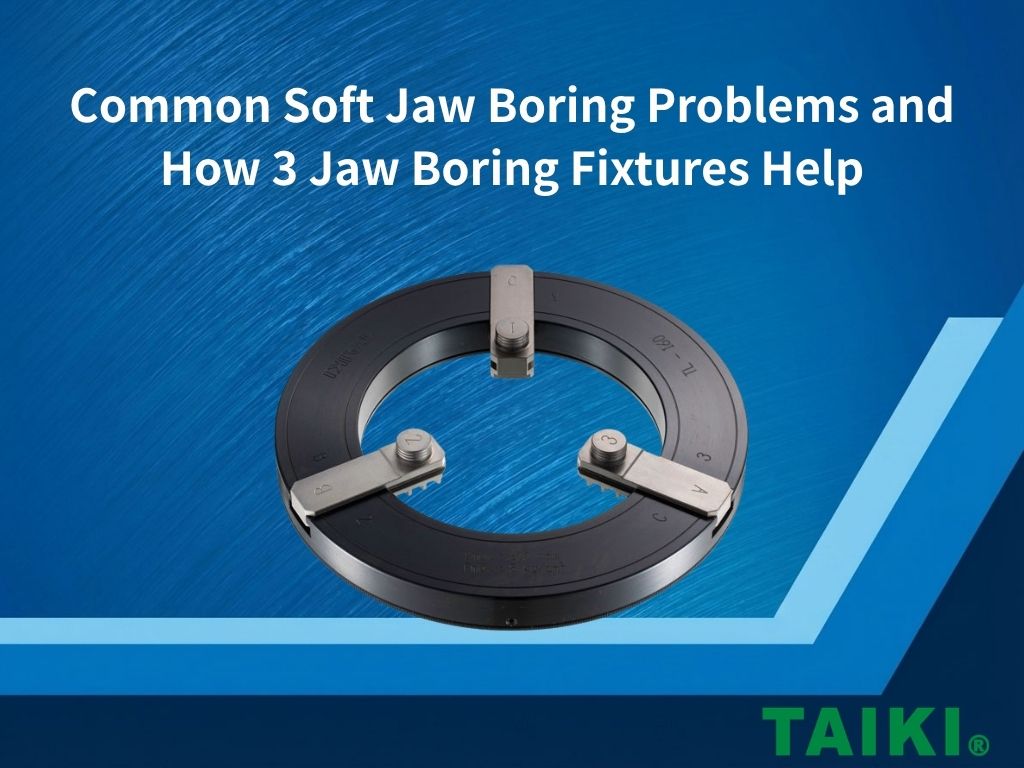
Common Soft Jaw Boring Problems and How 3 Jaw Boring Fixtures Help
Soft jaw boring is a critical step in preparing a CNC lathe for accurate and repeatable workholding. Even when high-quality soft jaws are used, an inconsistent boring setup can lead to poor workpiece contact, runout, repeated adjustments, or unnecessary re-boring.
3 Jaw Boring Fixtures help establish a controlled jaw position during the boring process. By supporting a more consistent soft jaw preparation procedure, they can help CNC users improve setup repeatability and reduce avoidable variation before production begins.
At TAIKI INDUSTRIAL CO., LTD., we view soft jaw preparation as part of the complete workholding system—not simply as an isolated machining step.
Table of Contents
- Quick Answer: What Does a 3 Jaw Boring Fixture Do?
- Why Does Soft Jaw Boring Accuracy Matter?
- Problem 1: Boring Soft Jaws Without a Controlled Jaw Condition
- Problem 2: Inconsistent Soft Jaw Boring Between Setups
- Problem 3: Poor Contact Between Soft Jaws and the Workpiece
- Problem 4: Repeated Adjustments and Unnecessary Re-Boring
- How Do 3 Jaw Boring Fixtures Fit Into the Soft Jaw Preparation Process?
- 3 Jaw Boring Fixtures vs. Jaw Boring Rings: Are They the Same?
- What Benefits Can a Controlled Soft Jaw Boring Setup Provide?
- TAIKI's Approach to Complete Workholding Solutions
- FAQ: Common Questions About 3 Jaw Boring Fixtures
- Conclusion: Better Soft Jaw Boring Begins with a Controlled Setup
Quick Answer: What Does a 3 Jaw Boring Fixture Do?
A 3 Jaw Boring Fixture is a setup tool used while boring soft jaws on a three-jaw chuck. Its purpose is to help hold the jaws in a controlled position while the required clamping profile is machined.
A properly controlled boring condition helps the finished jaw profile correspond more closely to the condition in which the jaws will actually grip a workpiece.
In practical terms, the fixture helps make soft jaw preparation more systematic, repeatable, and easier to control.
Why Does Soft Jaw Boring Accuracy Matter?
Soft jaws are machined to create a clamping profile that matches the workpiece. The quality of this profile directly affects how the workpiece contacts the jaws after setup.
If the boring condition is inconsistent, several problems may occur:
- Uneven workpiece contact
- Increased runout
- Reduced positioning repeatability
- Unstable clamping
- Additional setup adjustments
- Unnecessary re-boring of the soft jaws
For this reason, accurate soft jaw boring depends not only on the cutting tool and boring diameter, but also on how the jaws are positioned during machining.
Problem 1: Boring Soft Jaws Without a Controlled Jaw Condition
One common soft jaw boring problem is machining the jaws without properly controlling their position.
During actual production, the chuck applies force to the jaws as they clamp the workpiece. If the jaw position during boring differs significantly from the position during actual clamping, the finished profile may not correspond correctly to the intended workholding condition.
A 3 Jaw Boring Fixture helps establish a controlled position for all three jaws while the profile is being machined.
The goal is not simply to hold the jaws in place. It is to create a more predictable and repeatable boring condition before the workpiece enters production.
Problem 2: Inconsistent Soft Jaw Boring Between Setups
Repeatability becomes particularly important when a CNC lathe is frequently changed over for different parts.
Each time another set of soft jaws is prepared, the boring procedure must be established again. If the process depends too heavily on manual positioning or operator judgment, the finished jaw profiles may vary between setups.
Using a 3 Jaw Boring Fixture as part of a standardized procedure can help operators:
- Establish a more consistent jaw position
- Reduce setup-to-setup variation
- Create a repeatable boring process
- Simplify soft jaw preparation for recurring jobs
For production environments that frequently change workpieces, consistency at the setup stage can help reduce unnecessary adjustments later.
Problem 3: Poor Contact Between Soft Jaws and the Workpiece
One of the main reasons for boring soft jaws is to create a clamping surface that closely matches the workpiece.
When the finished jaw profile does not correspond well to the actual workpiece or clamping condition, contact can become uneven. Increasing chuck pressure is not necessarily the correct solution because excessive force may create other workholding problems.
A better approach is to review the complete soft jaw preparation process.
Using an appropriate boring fixture helps establish a controlled condition before the profile is machined. Combined with correct boring dimensions and proper machining practices, this can support more consistent workpiece contact.
Problem 4: Repeated Adjustments and Unnecessary Re-Boring
Poor soft jaw preparation can create additional work after the boring operation is complete.
For example, an operator may:
- Bore the soft jaws.
- Install the workpiece.
- Check the setup.
- Discover poor contact or unacceptable runout.
- Remove the workpiece.
- Adjust or re-bore the jaws.
Every unnecessary re-boring operation removes additional material from the soft jaws.
A more controlled setup using 3 Jaw Boring Fixtures can help reduce avoidable trial-and-error. However, the fixture is only one part of the process. Boring diameter, jaw condition, cutting parameters, chuck pressure, and operator technique must also be considered.
How Do 3 Jaw Boring Fixtures Fit Into the Soft Jaw Preparation Process?
A 3 Jaw Boring Fixture should be viewed as part of a complete preparation process rather than as a standalone solution.
A typical soft jaw preparation sequence includes:
- Selecting the correct soft jaws.
- Installing them correctly on the chuck.
- Establishing the required jaw condition for boring.
- Machining the necessary clamping profile.
- Checking the bored surface and dimensions.
- Verifying workpiece contact and positioning.
The boring fixture supports the third and fourth stages by helping maintain a controlled jaw position during profile machining.
This makes the fixture part of a broader workholding strategy rather than simply an accessory.
3 Jaw Boring Fixtures vs. Jaw Boring Rings: Are They the Same?
No. 3 Jaw Boring Fixtures and Jaw Boring Rings are both used during soft jaw preparation, but they should not automatically be treated as identical tools.
Their design, setup method, and suitable applications can differ.
The appropriate solution depends on factors such as:
- Chuck configuration
- Soft jaw design
- Required boring method
- Jaw movement
- Workpiece requirements
- Specific setup conditions
Instead of asking which tool is universally better, CNC users should determine which method establishes the appropriate jaw condition for the particular boring operation.
This is why soft jaws, boring tools, chuck accessories, and the chuck itself should be considered as an integrated workholding system.
What Benefits Can a Controlled Soft Jaw Boring Setup Provide?
When the complete setup is properly planned, a controlled soft jaw boring process can support several production benefits.
| Workholding Requirement | Potential Benefit |
|---|---|
| Consistent jaw positioning | More repeatable soft jaw preparation |
| Controlled boring setup | Reduced setup variation |
| Proper jaw profile | Better workpiece contact |
| Fewer corrective operations | Less unnecessary re-boring |
| Standardized setup procedure | Easier repeat production |
A 3 Jaw Boring Fixture contributes to these benefits by supporting a more controlled boring condition. The final machining result still depends on the complete setup and operating parameters.
TAIKI's Approach to Complete Workholding Solutions
TAIKI has become the specialist in manufacturing soft jaws for all popular power chucks, along with a complete range of chuck accessories.
Our approach extends beyond supplying individual soft jaws. We understand that workholding performance also depends on how the jaws are installed, prepared, machined, and used with the chuck system.
TAIKI provides a range of products including:
- Soft jaws
- Round jaws
- Jaw T-Nuts
- Jaw boring rings
- 3 Jaw Boring Fixtures
- Other chuck accessories
By bringing these components together, TAIKI supports CNC users throughout the workholding process—from soft jaw preparation to actual production machining.
FAQ: Common Questions About 3 Jaw Boring Fixtures
Q1: What is a 3 Jaw Boring Fixture used for?
A 3 Jaw Boring Fixture is used during soft jaw preparation to help maintain the three jaws in a controlled position while the required clamping profile is bored. This supports a more consistent and repeatable soft jaw setup.
Q2: Why is controlling the jaw position important during soft jaw boring?
The position of the jaws during boring influences the geometry of the finished clamping profile. A controlled setup helps the profile better correspond to the intended workholding condition and can reduce setup variation.
Q3: Is a 3 Jaw Boring Fixture the same as a Jaw Boring Ring?
No. Both are associated with soft jaw preparation, but their designs and setup methods differ. The appropriate tool should be selected according to the chuck, jaw configuration, boring method, and specific machining requirements.
Conclusion: Better Soft Jaw Boring Begins with a Controlled Setup
Soft jaw boring problems are not always caused by the soft jaws themselves. The way the jaws are prepared can have a major influence on the final workholding result.
Inconsistent boring conditions, poor jaw positioning, and repeated corrective machining can reduce production efficiency and consume additional soft jaw material.
3 Jaw Boring Fixtures provide CNC users with a practical way to establish a more controlled condition during soft jaw boring. When combined with correctly selected soft jaws and appropriate machining practices, they become an important part of a reliable and repeatable workholding preparation process.
Contact TAIKI INDUSTRIAL CO., LTD. to learn more about our 3 Jaw Boring Fixtures, soft jaws, and complete range of chuck accessories for CNC workholding applications.