
The Role of Jaw T-Nuts in a Complete Workholding System
In CNC turning operations, precision does not rely on a single component. True machining stability comes from how each element within the workholding system functions together. While soft jaws often receive the most attention, the integrity of the mounting interface—particularly Jaw T-Nuts—plays an equally critical role.
Jaw T-nuts may appear to be small mechanical parts, but they form the structural connection between soft jaws and the chuck body. Without stable and accurate T-nuts, even the most precisely manufactured jaws cannot perform consistently.
At TAIKI INDUSTRIAL CO., LTD., we view Jaw T-Nuts not as standalone hardware, but as an integral part of a complete workholding solution.
What Are Jaw T-Nuts?
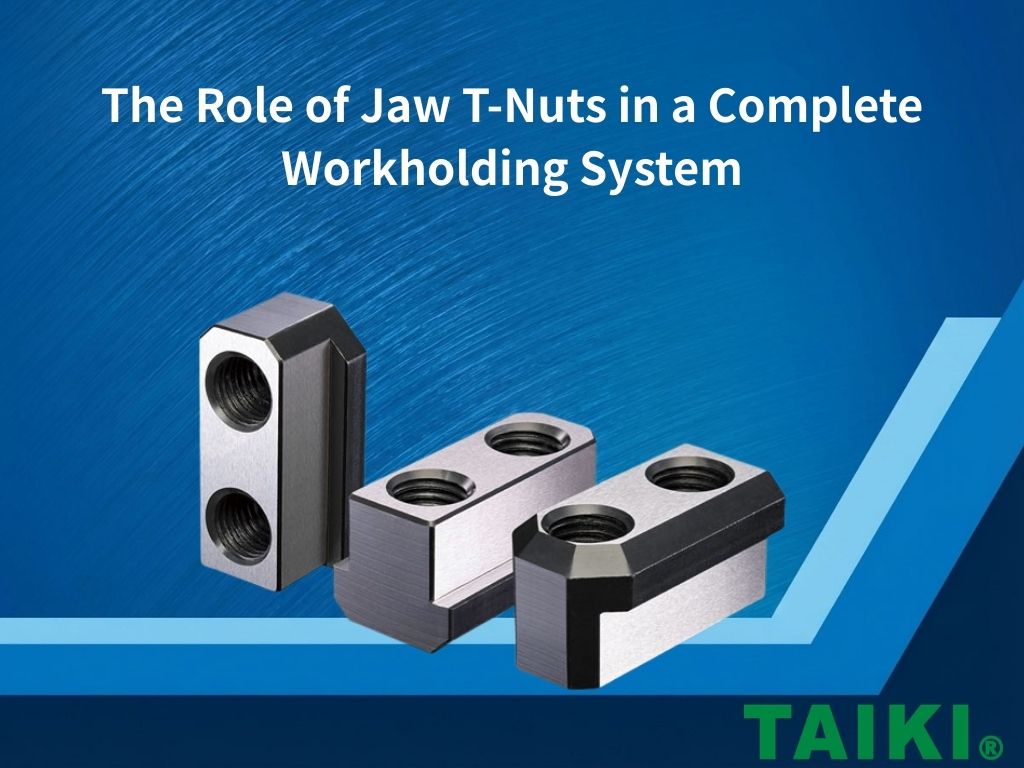
Jaw T-Nuts are specialized fastening components designed to secure soft jaws to power chucks. They fit into the T-slots of the chuck and serve as the mechanical anchor that transmits clamping force from the chuck to the jaws.
Unlike generic T-nuts used in standard mechanical assemblies, Jaw T-Nuts are engineered specifically for workholding applications. They must:
-
Maintain precise dimensional tolerances
-
Ensure correct jaw positioning
-
Withstand repeated clamping forces
-
Resist deformation under load
In CNC machining, where accuracy often depends on microns, the quality and fit of Jaw T-Nuts directly influence clamping alignment and repeatability.
Why Jaw T-Nuts Matter in Workholding Stability
The stability of a workholding system depends on how effectively force is transferred.
When clamping force is applied, the load path moves from the chuck piston to the jaws, and ultimately to the workpiece. Jaw T-Nuts sit at the core of this load transfer chain.
If T-nuts are poorly manufactured, worn, or improperly matched:
-
Jaw alignment may shift
-
Clamping force may distribute unevenly
-
Concentricity may degrade over time
-
Runout variation may increase
Because Jaw T-Nuts define the positioning interface between chuck and jaw, they influence the entire geometry of the workholding system.
In high-precision production environments, even minimal instability at this interface can accumulate into measurable dimensional variation.
Jaw T-Nuts as Part of a Complete Workholding System
A modern CNC workholding system consists of multiple interrelated components:
-
Soft jaws
-
Jaw boring rings
-
Jaw T-nuts
-
Jaw boring fixtures
-
Power chuck systems
Each element contributes to overall accuracy and stability.
Soft jaws provide customized clamping surfaces.
Jaw boring rings ensure preload simulation during setup.
Jaw boring fixtures support precision machining of jaws.
Jaw T-nuts secure the entire assembly to the chuck body.
When these components are engineered to work together, they create a controlled and repeatable clamping environment.
This integrated approach minimizes setup variability and supports consistent batch production.
Compatibility and Precision: Critical Selection Factors
Choosing the correct Jaw T-Nuts requires careful consideration of:
-
Chuck brand and model compatibility
-
T-slot dimensions
-
Material strength
-
Surface treatment for durability
-
Long-term wear resistance
Jaw T-Nuts must precisely match the chuck interface. Even slight dimensional mismatch can introduce micro-movement during operation, affecting long-term accuracy.
In automated or high-speed CNC environments, mechanical stability becomes even more important. Consistent mounting geometry supports better repeatability across production cycles.
From Component Supply to Workholding Solutions
TAIKI has become the specialist in manufacturing soft jaws for all popular power chucks, along with a complete range of chuck accessories.
Our philosophy is rooted in system-level thinking. We understand that the reliability of soft jaws depends not only on jaw design, but also on the strength and precision of the mounting interface.
By offering Jaw T-Nuts alongside soft jaws, jaw boring rings, and other chuck accessories, we provide customers with a cohesive workholding ecosystem.
This ensures compatibility, dimensional accuracy, and stable clamping performance across diverse CNC applications.
For manufacturers focused on long-term process stability, selecting integrated workholding components is a strategic advantage.
FAQ: Common Questions About Jaw T-Nuts
Q1: Are Jaw T-Nuts interchangeable between different chuck brands?
Not always. Jaw T-Nuts must match specific chuck models and T-slot dimensions. Using incompatible T-nuts can compromise alignment and clamping security.
Q2: Can worn Jaw T-Nuts affect machining accuracy?
Yes. Over time, wear or deformation may introduce slight positional shifts, leading to reduced repeatability and potential runout variation.
Q3: Why should I choose workholding-specific T-nuts instead of standard hardware?
Workholding applications require higher precision and load capacity than general fastening solutions. Jaw T-Nuts are engineered specifically for secure and accurate jaw mounting under repeated clamping cycles.
Conclusion: Small Components, Critical Impact
In CNC machining, stability begins at the interface.
Jaw T-Nuts may be compact components, but their influence on clamping security, alignment, and long-term accuracy is substantial. As part of a complete workholding system, they ensure that soft jaws perform reliably under real operating conditions.
For manufacturers seeking consistent precision and system-level reliability, investing in properly engineered Jaw T-Nuts is not an accessory decision—it is a structural necessity.
➤ Contact TAIKI INDUSTRIAL CO., LTD. to learn more about our complete range of soft jaws, Jaw T-Nuts, and integrated workholding.