
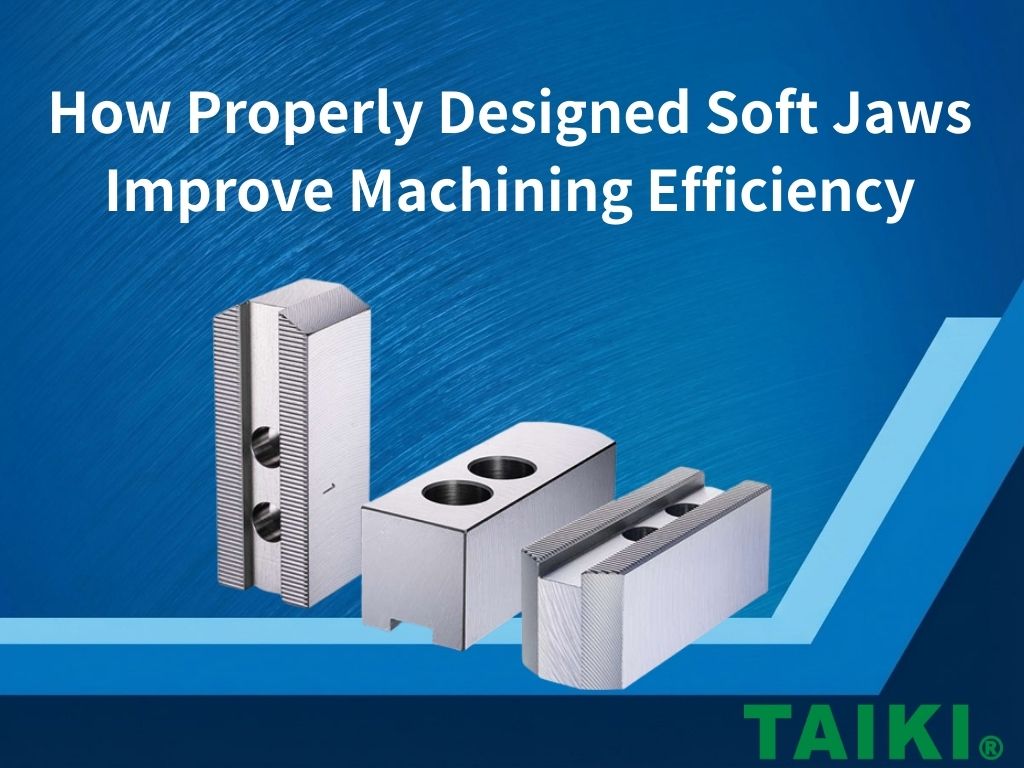
How Properly Designed Soft Jaws Improve Machining Efficiency
In modern CNC machining, productivity and accuracy are key to maintaining competitiveness. One often underestimated factor that significantly impacts both is the design of the Soft Jaws used for workholding. While these components may appear simple, their geometry, material, and precision determine how securely and consistently a workpiece can be clamped during high-speed operations. At TAIKI INDUSTRIAL CO., LTD., we specialize in developing and manufacturing high-quality soft jaws that optimize machining efficiency and precision across various industries.
Understanding the Function of Soft Jaws
Soft jaws are custom-machined clamping components mounted onto power chucks or manual chucks to hold a workpiece firmly in place. Unlike standard hard jaws, soft jaws are made from machinable materials such as mild steel or aluminum, allowing them to be bored to match the exact contour of a specific part. This customization ensures maximum contact, excellent concentricity, and reduced distortion—key factors for precision machining.
When properly designed, soft jaws do more than just hold the workpiece; they also enhance repeatability, surface finish, and overall cycle time of machining processes. Poorly designed or worn jaws, on the other hand, can lead to vibration, chatter, and dimensional errors that compromise productivity.
1. Enhanced Concentricity and Dimensional Accuracy
One of the greatest advantages of properly designed soft jaws is improved concentricity—the alignment of the workpiece with the spindle axis. When a soft jaw is bored in place on the chuck, it compensates for any runout or misalignment, allowing each part to be clamped consistently at the same centerline. This precise positioning minimizes rework and improves dimensional accuracy, especially in turning and finishing operations where tolerances are tight.
At TAIKI INDUSTRIAL CO., LTD., our soft jaws are engineered to maintain perfect alignment under varying loads. Whether for high-speed cutting or heavy-duty turning, the result is smoother operation, less vibration, and longer tool life.
2. Reduced Setup Time and Increased Productivity
In manufacturing, setup time directly affects production efficiency. Using well-designed soft jaws can dramatically reduce setup time between batches. Once the jaws are bored to a specific part geometry, operators can quickly load and unload workpieces without frequent adjustments or re-centering. This repeatability is especially valuable in high-volume production lines or automated CNC cells.
TAIKI’s standardized and custom soft jaws are designed for quick installation and compatibility with multiple chuck types, helping manufacturers achieve faster changeovers and minimize downtime.
3. Improved Surface Finish and Workpiece Protection
A critical aspect of machining efficiency is the quality of the finished part. Excessive clamping pressure or uneven contact can cause distortion, marring, or slippage—leading to scrap or rework. Properly designed soft jaws distribute the clamping force evenly over the contact area, minimizing stress concentrations and maintaining the workpiece’s integrity.
TAIKI soft jaws can be machined to fit complex geometries, delicate materials, or thin-walled components. This ensures a stable yet gentle grip that preserves surface quality while allowing for high-speed, high-precision machining operations.
4. Consistent Clamping Force and Reduced Tool Wear
Uneven or unstable clamping leads to micro-vibrations that accelerate tool wear and reduce surface accuracy. By using precision-engineered soft jaws, the clamping force remains balanced and consistent throughout the machining cycle. The improved stability allows the cutting tool to engage more smoothly, extending its lifespan and improving cutting performance.
TAIKI’s design process emphasizes uniform contact surfaces and optimized jaw profiles. This ensures that clamping force is efficiently transmitted, eliminating micro-movement and maintaining consistent machining conditions even during long production runs.
5. Customization for Complex or Specialized Parts
Not all workpieces can be clamped with standard jaws. Complex geometries, irregular shapes, and large diameters often require specialized designs. TAIKI INDUSTRIAL CO., LTD. offers both standard and custom soft jaw solutions tailored to your specific applications. Our engineering team works closely with customers to determine the ideal jaw design, material, and machining method for each project.
From aerospace components and automotive parts to semiconductor tooling, our customized soft jaws are designed to deliver precision, repeatability, and maximum holding performance.
TAIKI’s Commitment to Quality and Performance
Since 1975, TAIKI INDUSTRIAL CO., LTD. has been dedicated to manufacturing superior soft jaws, hard jaws, and round jaws for global customers. Each jaw undergoes rigorous inspection for dimensional accuracy, surface finish, and material integrity. Our production integrates advanced machining processes and continuous quality control to ensure consistency and reliability in every batch.
With our extensive experience and wide product range—including standard, aluminum, and special-type soft jaws—TAIKI supports industries that demand precision and efficiency in every operation.
Conclusion: Small Components, Big Impact
Soft jaws may seem like a minor component, but in precision machining, they play a major role in achieving efficient, reliable, and accurate results. A properly designed soft jaw enhances concentricity, reduces setup time, protects workpieces, and ensures smooth tool performance—all of which contribute to higher productivity and lower operational costs.
☛ Contact TAIKI INDUSTRIAL CO., LTD. today to learn how our precision-engineered soft jaws can optimize your machining efficiency and support your production goals.