
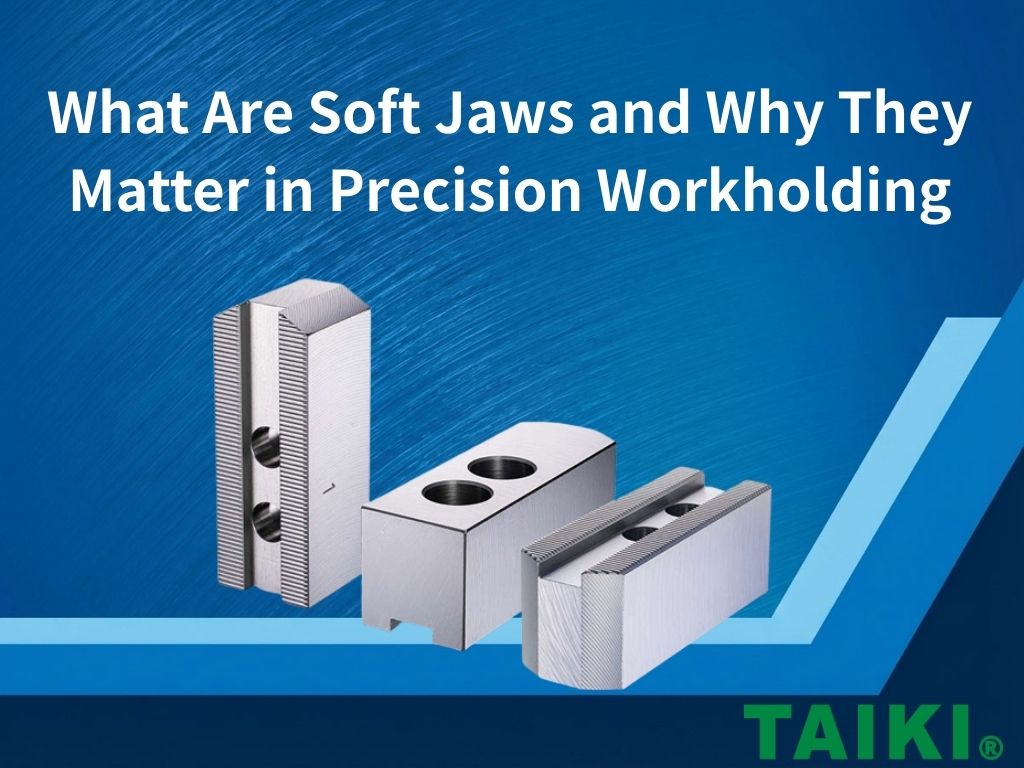
What Are Soft Jaws and Why They Matter in Precision Workholding
In modern CNC machining, precision and repeatability define the difference between ordinary production and world-class manufacturing. One often overlooked but essential component that plays a decisive role in achieving these results is the Soft Jaw. At TAIKI INDUSTRIAL CO., LTD., we have dedicated nearly five decades to designing and manufacturing high-quality soft jaws, ensuring that our customers’ workpieces are clamped with accuracy, reliability, and consistency.
Understanding What Soft Jaws Are
Soft jaws are customized or semi-finished clamping components mounted onto power chucks or manual chucks. They are made from materials such as medium carbon steel and aluminum that can be bored or shaped to match the exact contour of a workpiece.
Unlike standard hard jaws, which are designed for general-purpose use, soft jaws are machined to fit a specific part geometry — ensuring maximum contact and minimal deformation during machining.
In other words, a well-designed soft jaw acts like a “custom glove” for your workpiece. It allows precise positioning, firm clamping, and excellent surface protection, which are critical in high-precision turning, milling, and grinding operations.
Why Soft Jaws Are Essential for Precision Machining
When machining delicate, thin-walled, or irregularly shaped components, traditional hard jaws may cause distortion or slippage. Soft jaws eliminate these risks by providing tailored contact surfaces. The advantages include:
- Higher Concentricity: Machining soft jaws in place ensures that the bore is perfectly aligned with the chuck axis.
- Reduced Setup Time: Once machined, soft jaws allow repeat loading of identical parts without further adjustment.
- Improved Surface Finish: Gentle yet secure clamping minimizes marks or scratches on finished components.
- Enhanced Process Stability: Consistent clamping force translates into more predictable machining results.
These benefits make soft jaws indispensable in industries where tolerances are tight and quality standards are strict — such as automotive, aerospace, semiconductor, and mold manufacturing.
TAIKI’s Expertise in Soft Jaw Manufacturing
Founded in 1975, TAIKI INDUSTRIAL CO., LTD. has evolved into a leading Taiwanese manufacturer of soft jaws, chuck jaws, and related workholding accessories.
Our expertise lies in both standardized production and custom-engineered solutions. For customers who need unique shapes or special gripping requirements, TAIKI’s experienced engineering team collaborates closely to design and machine soft jaws that perfectly match their chucks and workpieces.
We understand that each operation is different — whether it involves high-speed turning, heavy-duty cutting, or fine finishing — and we tailor our jaws accordingly. This flexibility has earned TAIKI a reputation as a trusted partner among OEMs and machine tool users around the world.
Material Selection and Quality Commitment
The choice of material directly affects the performance and lifespan of soft jaws. TAIKI uses only high-grade, fully traceable materials such as carbon steel, alloy steel, and aluminum, depending on the application’s clamping force and wear resistance requirements.
Every step of production — from raw material inspection and CNC machining to final grinding and assembly — is subject to strict quality control. Our team performs dimensional checks, hardness testing, and concentricity verification to guarantee that each jaw meets or exceeds industry expectations.
In addition, TAIKI continually invests in improving our processes to ensure consistent quality, efficient delivery, and competitive pricing, giving our customers the confidence that every jaw delivered will perform precisely as intended.
FAQ: Common Questions About Soft Jaws
Q1: How long do soft jaws typically last?
The lifespan depends on the frequency of use and the material being machined. With proper setup and maintenance, TAIKI soft jaws can maintain precision over many production cycles.
Q2: Can soft jaws be reused for different parts?
While they can be re-machined to fit new workpieces, we recommend dedicating each set of soft jaws to a single part type to ensure consistent accuracy.
Q3: What materials are best for soft jaws?
TAIKI commonly uses carbon steel for general applications and aluminum for delicate or lightweight parts. The right choice depends on the required strength, wear resistance, and workpiece material.
Partnering for Precision
In the world of high-precision machining, the smallest details make the biggest difference. Choosing the right Soft Jaw is not just about holding a part — it’s about holding accuracy, consistency, and performance.
At TAIKI INDUSTRIAL CO., LTD., we believe in building long-term partnerships through dependable products and professional service. Whether you need standard soft jaws for your CNC lathe or a custom-engineered clamping solution, our team is ready to assist you from design to delivery.
☞ Contact TAIKI today to discuss your workholding requirements and discover how our soft jaws can elevate your machining performance.